Earlier than Fidget Toys, There Had been Beads: The Newest Craze is A part of a Lengthy Custom of Preserving Your Fingers Busy

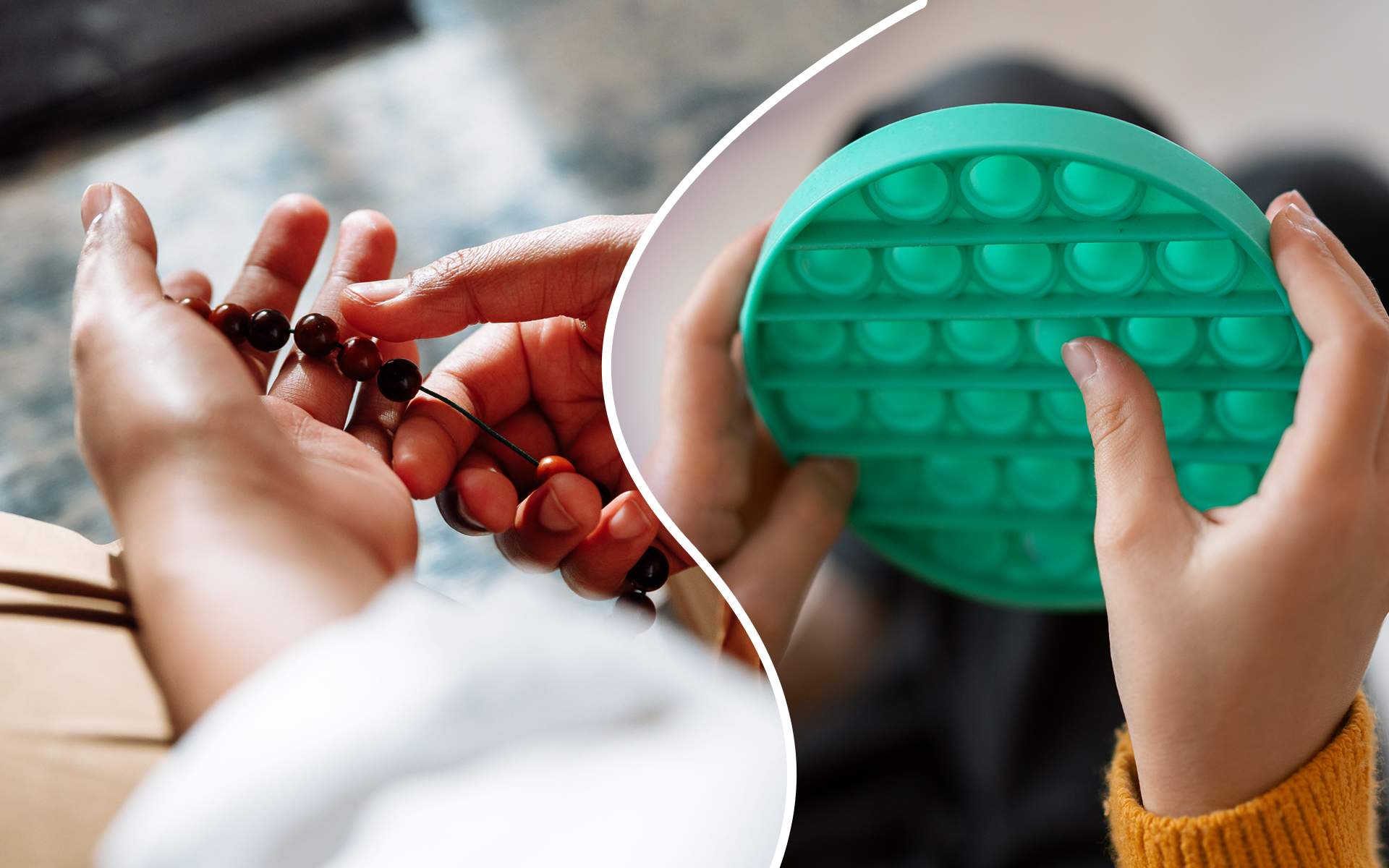

In 2005, I spent a semester in India on a Buddhist Research program. For my unbiased research venture, I researched the ritual circumambulation of Tibetan Buddhists, and spent three weeks observing practitioners strolling clockwise round holy websites whereas muttering mantras and thereby enhancing their karma.
One attention-grabbing observe was that just about no practitioner circumambulated empty handed. Whether or not they had been turning a mala (the sanskrit phrase for meditation beads), or spinning a prayer wheel, virtually everybody was conserving their arms occupied. The express level of such handiwork is to behave as a karma amplifier—on this custom, it’s understood that simply as strolling round a holy website supplies helpful karma, so does turning a sacred object clockwise whereas circumambulating.
However it is usually indicative of the truth that, greater than another creature, people like conserving their arms occupied.
Occupying one’s arms with one thing repetitive, whether or not it’s rotating a mala, knitting, or coloring, appears to offer a sensory anchor and act as a dependable antidote to racing ideas.
A Transient Historical past of “Busy Fingers, Quiet Thoughts”
There’s proof of people stringing beads over 120,000 years in the past. Meditation beads first appeared in Hindu texts within the eighth century BCE. Prayer beads have additionally been used for hundreds of years in each Christian and Islamic practices.
There’s a cause the phrase “busy arms, quiet thoughts” is a part of the lexicon. Occupying one’s arms with one thing repetitive, whether or not it’s rotating a mala, knitting, or coloring, appears to offer a sensory anchor and act as a dependable antidote to racing ideas.
Just lately I skilled this primary hand (pun meant). At a college assembly, the varsity counselor was occupying his arms by cleansing among the fidgets he provides out to center schoolers, and he tossed me one. I performed with it all through a really dry presentation on advantages, and to my shock, I used to be locked in. I’ve by no means thought-about myself somebody with attentional points, but having an object with which to dump my extra power helped my keep surprisingly current.
What strikes me in regards to the fidget craze isn’t that we’re promoting out of squishy, kneadable toys, however that it took us so lengthy to understand that the sensory anchors that adults have been utilizing for millenia may additionally be helpful for youths.
The expertise jogged my memory of my very own center faculty days, when, a lot to the chagrin of our academics, everybody tried to study pencil tips, twirling them and spinning them repetitively, ensuing within the incessant clattering of writing utensils on tile flooring. In these days, fidgets weren’t a part of the attentional arsenal, so maybe we had been all merely improvising. Now fidgets are so well-liked there has even been a scarcity of 1 well-liked model.
What strikes me in regards to the fidget craze isn’t that we’re promoting out of squishy, kneadable toys, however that it took us so lengthy to understand that the sensory anchors that adults have been utilizing for millenia may additionally be helpful for youths.
Attentional Aids for Completely different Learners
The primary fidget spinner was invented by Catherine Hettinger in 1993, nevertheless it didn’t appeal to a lot curiosity on the time. Then, within the spring of 2017, aided by social media, fidget spinners took off. Improvements adopted, with sensory cubes, stress balls, and silicone popping toys serving to the business change into a $9 billion greenback international behemoth.
After all, a lot of the enchantment of fidgets is that they’re enjoyable, colourful, cute, and collectible. But therapists, counselors, and educators additionally observed how priceless these things might be for neurodiverse learners with autism, nervousness, and ADHD.
“The repetitive motion and sensory enter is soothing for the nervous system because it discharges power,” defined Dr. Corinne Buchanan, a licensed psychological well being counselor, mindfulness trainer, and teacher on the College of Florida. “In flip, this will help present ‘noisy’ minds with sufficient sensory enter to permit the mind to higher concentrate on different stimuli, resembling a much less stimulating class lecture.”
These advantages have been confirmed by analysis. One research discovered that college students with ADHD had been capable of keep on process higher when utilizing fidget spinners. One other research confirmed that permitting college students to fidget boosted creativity.
There’s a crucial distinction professionals make in figuring out fidgets as instruments, not toys.
Assist In Therapeutic Settings, As Nicely
Fidgets have additionally proved to be helpful instruments in medical settings. Dr. Katharine Evarts, a licensed medical psychologist and Director of Scholar Affairs at Antioch College, famous, “As therapists, it’s essential for us to have quite a few examples of ‘grounding methods’—resembling tactile sensory experiences that draw one’s consideration to the present second—readily available each time working with purchasers experiencing panic, nervousness assaults, trauma triggers, and even, frankly, intense feelings of any form.”
But there’s a crucial distinction these professionals make in figuring out fidgets as instruments, not toys. As Josh Sussman, the counselor at my faculty (and the one that tossed me a fidget at our college assembly) wrote in a e-newsletter to our neighborhood on the topic, “The device is meant to assist one’s eyes keep on the world in entrance of them and one’s mind to concentrate on the duty at hand. If it begins for use as a toy, it’s time to revisit the aim of the fidget and make changes to when it could be applicable to make use of it.”
As these objects for settling the nervous system and grounding consideration change into extra well-liked, they’ve normalized the concept that being seated and nonetheless just isn’t at all times essentially the most optimum approach for college students to study or course of feelings.
As these objects for settling the nervous system and grounding consideration change into extra well-liked, they’ve normalized the concept that being seated and nonetheless just isn’t at all times essentially the most optimum approach for college students to study or course of feelings. By serving to our our bodies and minds be in the identical place on the similar time, additionally they helped bridge the hole between our exterior and inner worlds, a process mindfulness practitioners have been partaking in for a very long time.
Alignment of Physique and Thoughts
Thanks partially to Descartes, who gave primacy to our psychological expertise along with his dictum, “I feel, due to this fact I’m,” we within the West have usually conceived of physique and thoughts as separate.
But this distinction is one that’s more and more eroding as we perceive extra in regards to the mind. It is usually a distinction that doesn’t happen as a lot in Jap traditions, the place mindfulness follow has had a long-lasting affect.
“Not all perception methods deal with these realms as separate,” mentioned Buchanan. “And in reality, as a somatic therapist, I might argue we’ve many examples of how our psychological states influence our bodily states and our bodily states can influence our psychological states in flip.”
For a lot of mindfulness practitioners, beads act as a way of constructing this connection extra obvious when it feels foggy. As a Zen practitioner, I’ve been taught to align the turning of my mala with the rising and falling of my breath to offer an anchor when discursive ideas really feel intractable.
Tuning into sensation may be very totally different from the tuning out we’d do when partaking with screens: Tactile engagement triggers the parasympathetic nervous system and results in a bodily calming, moderately than dissociation.
Evarts described how this sort of tuning into sensation may be very totally different from the tuning out we’d do when partaking with screens: “Tactile engagement triggers the parasympathetic nervous system and results in a bodily calming, moderately than dissociation. Slightly than erasing the remainder of ourselves in favor of immersion in a tv present or fast-paced quick video digestion, hands-on engagement facilitates a fuller embodiment of ourselves by means of mindfully specializing in all of our senses and the current second.”
In an period during which dissociation is more and more accessible, having a countermeasure to assist align physique and thoughts could be a significant arrow within the attentional quiver. Regardless of the flashy colours and whizzbang delights of recent fidgets, they’re rooted in a convention of sensory grounding implements that dates again millenia. Making them accessible as a device isn’t a distraction however a approach to fight the rampant tendency for distraction in a world filled with it. The times of incessant pencil clattering may lastly be over.