Interior Calm: The Secret’s Letting Go



We regularly hear about interior calm, however it may be a lot greater than a fleeting second of peace after yoga or the right therapeutic massage. Interior calm is definitely our capability to let go of attachments and reactions to life’s occasions, leading to ease and readability.
As a mindfulness ability, interior calm is the flexibility to let go of attachments and reactivity primarily based on an understanding of impermanence—the altering nature of our ideas, feelings, and needs. After we discover ourselves dashing and reacting, we are able to remind ourselves, This too shall go. The aim is to not negate what we’re feeling however to place brakes on accelerated emotions. As soon as we return to our interior stillness, we are able to take a look at the supply of our reactivity, intimately seeing its altering nature: This proper here’s what frees us.
As soon as we return to our interior stillness, we are able to take a look at the supply of our reactivity, intimately seeing its altering nature: This proper here’s what frees us.
As a apply, interior calm is the artwork of stopping, trying and letting go for functions of therapeutic and readability. It includes bodily composure and psychological tranquility. It may be seen as the last word balm on your soul—like a cool breeze on a sizzling day. Interior calm brings ease to physique and thoughts alike. Within the physique, composure is skilled within the muscular tissues and as an total feeling of ease. Within the thoughts, interior calm creates the area to carry the whole lot with out attachment and resistance. Conversely, the absence of interior calm might present up as restlessness within the physique and agitation or reactivity within the thoughts.
In search of interior calm can typically go away us wanting extra, but it surely’s ironic that true interior calm is achieved after we let go of our needs, even the need for interior calm itself—a catch-22 if there ever was one. This paradox turns into evident after we think about the case of a shopper coping with nervousness who turned to meditation as a strategy to ease his thoughts. Surprisingly, he discovered himself much more anxious post-meditation. He had hoped that meditation would enhance his sleep, however he was left pissed off when he noticed his restlessness throughout a physique scan meditation, which solely appeared to worsen his sleep issues.
The ethical right here? To seek out peace, he needed to let go first of his expectations round discovering peace. To be able to let go, he discovered to see the three hindrances to his reaching mindfulness: operating in circles (a stressed thoughts), pulling (striving to sleep), and pushing (pissed off together with his restlessness). With apply, he discovered to simply accept his stressed thoughts, which softened the striving and frustration, and he was capable of finding ease, even when he couldn’t sleep, which in the end allowed him to sleep.
Letting go of attachments to sure outcomes doesn’t, nevertheless, imply that we’re suppressing or evading difficult conditions. As a substitute, this launch happens organically after we comprehend that feelings come up and dissolve—all inside ninety seconds.
The Ninety-Second Rule
Interior calm is just not about suppressing, denying, or avoiding our feelings. After we don’t give in to the urge to react, we’re cultivating the flexibility to stick with unpleasantness (understanding that feelings are physiological responses within the physique that may come up and dissolve). Simply as happiness triggered by exterior occasions doesn’t final, unfavorable feelings additionally don’t final. Have you ever heard of the ninety-second rule? Neuroscientist Jill Bolte Taylor reveals in her e-book My Stroke of Perception: A Mind Scientist’s Private Journey that every one feelings have a starting, center, and finish—all inside ninety seconds from once they first come up.
The rationale we proceed to expertise unfavorable feelings, generally for days, weeks, and even years, is that we proceed to gasoline these emotions with our narratives. As a substitute, if we cease and let the emotion transfer via our physique, we’ll create area in our minds to raised perceive what they’re attempting to inform us. Reasonably than suppressing or utilizing optimistic pondering to bypass our expertise, we are able to kind an alliance with our emotions. By doing this, we are able to uncover how they’re attempting to guard us, deal with our unmet wants, or draw our consideration to new info within the setting.
The ninety-second rule is a useful reminder to trip the waves of our feelings, however feelings can generally be so highly effective that they hijack our rational thought processes. It’s useful in these conditions to recollect the place these feelings come from—deep previously, after we have been hunter-gatherers dealing with actual tigers!
How Interior Calm Helps Resilience
A lot of our lives are marked by perceived threats to our id, profession, or relationships. Our primal reactions—fight-flight-freeze—might be unhelpful on the subject of navigating these on a regular basis psychological and social stressors. What’s wanted to resolve issues widespread to the fashionable world is readability and creativity, however our response is the other—to struggle, flee, or freeze. This evolutionary response to any menace is automated and unconscious.
What’s wanted to resolve issues widespread to the fashionable world is readability and creativity, however our response is the other—to struggle, flee, or freeze.
When our feelings are triggered such that we are able to’t assume or see clearly, it’s known as an “amygdala hijack”—a time period popularized by emotional intelligence professional Daniel Goleman. The amygdala is the emotional heart of the mind. One among its capabilities is to scan the setting for threats and put together the physique for an emergency response. When it perceives a menace, reminiscent of a tiger lurking within the bushes, it sends a direct sign to launch stress hormones—adrenaline and cortisol—that ramp up an emergency response. Blood stops flowing to the organs and as an alternative floods into the limbs to organize us for struggle or flight. In the meantime, the prefrontal cortex (which is liable for pondering and govt decision-making) shuts down as a result of there isn’t a time to assume and analyze after we’re dealing with what the mind perceives as a life-threatening state of affairs.
Throughout an amygdala hijack, it’s stated that our IQ briefly drops by ten to fifteen factors. Perhaps this explains that feeling after we’ve reacted to a verbal set off: What was I pondering after I stated that? That’s precisely the purpose. We cease pondering rationally. It additionally compromises reminiscence, which is why we are able to’t bear in mind a single advantage of an individual with whom we’ve a battle or why we are able to’t discover our keys in the course of a panic assault. Being in a steady state of struggle or flight from fashionable threats additionally compromises the integrity of different techniques, like immunity and digestion.
Cultivating interior calm is a crucial step in avoiding the amygdala hijack so we are able to assume clearly even in extremely charged conditions. Utilizing practices to advertise interior calm—like breath consciousness—helps gradual our escalating feelings and permits the parasympathetic nervous system to sit back in so we are able to as soon as once more assume clearly. One other exercise that nudges the prefrontal cortex to start out pondering once more is “noting” or “labeling.” The act of noting or labeling our feelings will get the prefrontal cortex to regain wholesome communication with the amygdala and avoids the hijack. Interior calm provides alternatives to be taught and enhance or for us to supply a deeper understanding of the “what” and the “why” behind our actions. We are able to substitute rigidity and misunderstanding with concord and understanding. Interior calm is vital for resilience in relationships and life typically.

The place Are You on the Interior Calm Continuum?
You’ll be able to strengthen your capability for interior calm, no matter your circumstances. First, take note of while you’re calm and while you’re not. Subsequent, discover the causes and situations that promote calm and what stops you from being calm. By cultivating a behavior of calming the thoughts and physique, you’ll develop the flexibility to entry this place extra shortly and simply.
Each day Follow: One-Minute Relaxation
Rested, we care once more for the appropriate issues and
the appropriate individuals in the appropriate manner.
—David Whyte
Take time in your day, a number of instances a day, if attainable, to empty your cup and make area for what issues. You are able to do this in a short time by checking in along with your physique.
- Any rigidity or tightness within the physique is a clue that you just’re holding on to one thing that wants your loving consideration. You’ll be able to’t let go with out understanding what it’s you’re attempting to let go. Simply turning your consideration to locations you’re holding rigidity might help you uncover the feelings and ideas related to that rigidity.
- As soon as you possibly can see the reason for your rigidity, you possibly can work out the answer. It’s additionally clarifying to realign along with your intentions as you’re emptying your cup—what’s it you’re clearing the area for?
- Return. Take a one-minute relaxation and return to your physique. Rub the palms of your hand and place them in your eyes, permitting them to relaxation. Transfer your palms to your jawline, neck, shoulders, chest, or wherever feels good in your physique.
- Pay attention. Pay attention inside. What are you able to let go of at this second to make room for what issues?
- Start. Start your actions with a relaxed physique and thoughts aligned with what issues.
Attempt working towards and taking part in with this reminder with your loved ones, with workforce members, and in your neighborhood earlier than starting a gathering or exercise collectively.
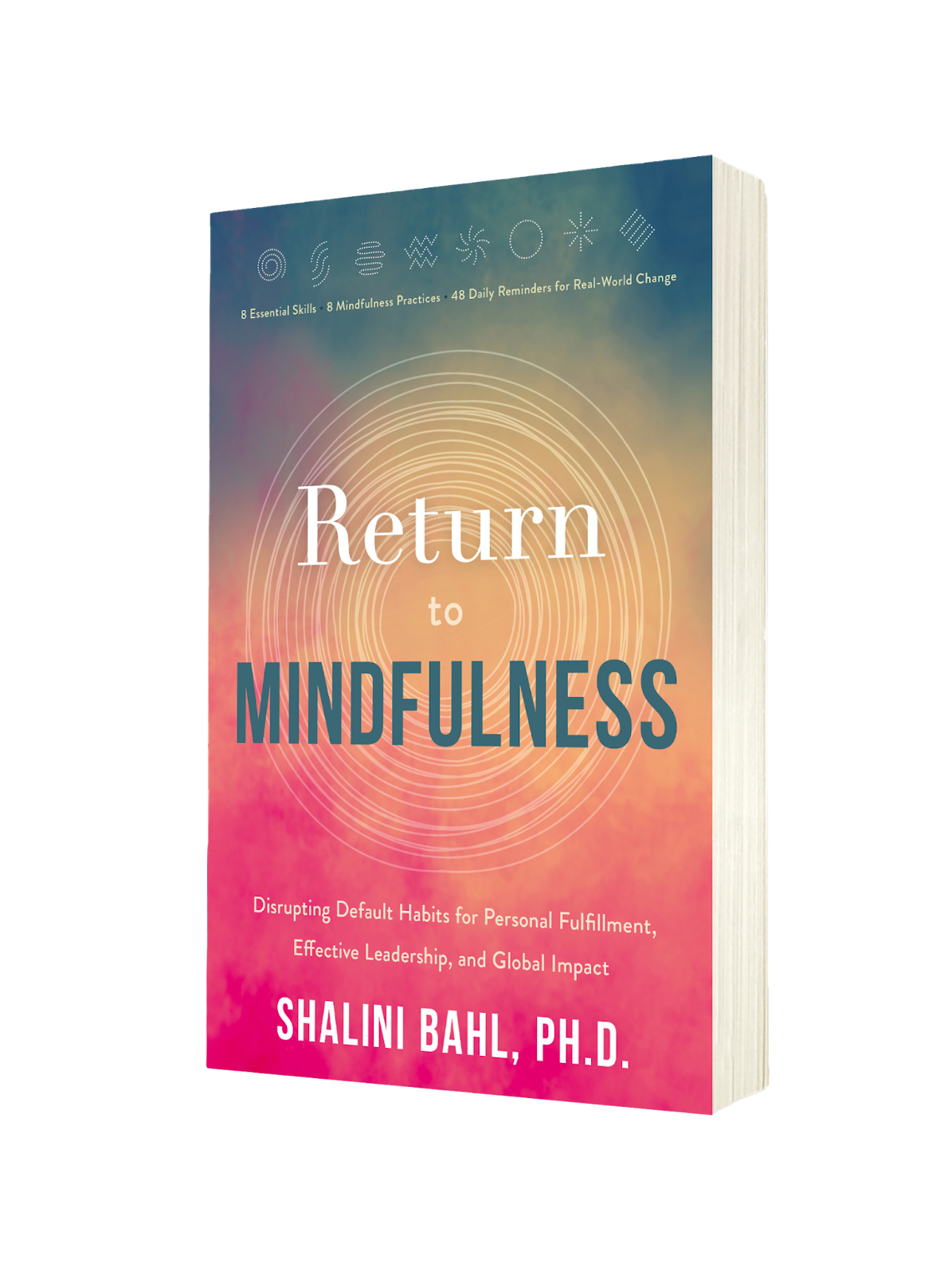
Excerpted from the e-book Return to Mindfulness: Disrupting Default Habits for Private Success, Efficient Management, and International Impression by Shalini Bahl Milne. Copyright © 2024 Shalini Bahl Milne. Republished with permission from the creator. Return to Mindfulness will probably be out there on Amazon on January 18, 2024.